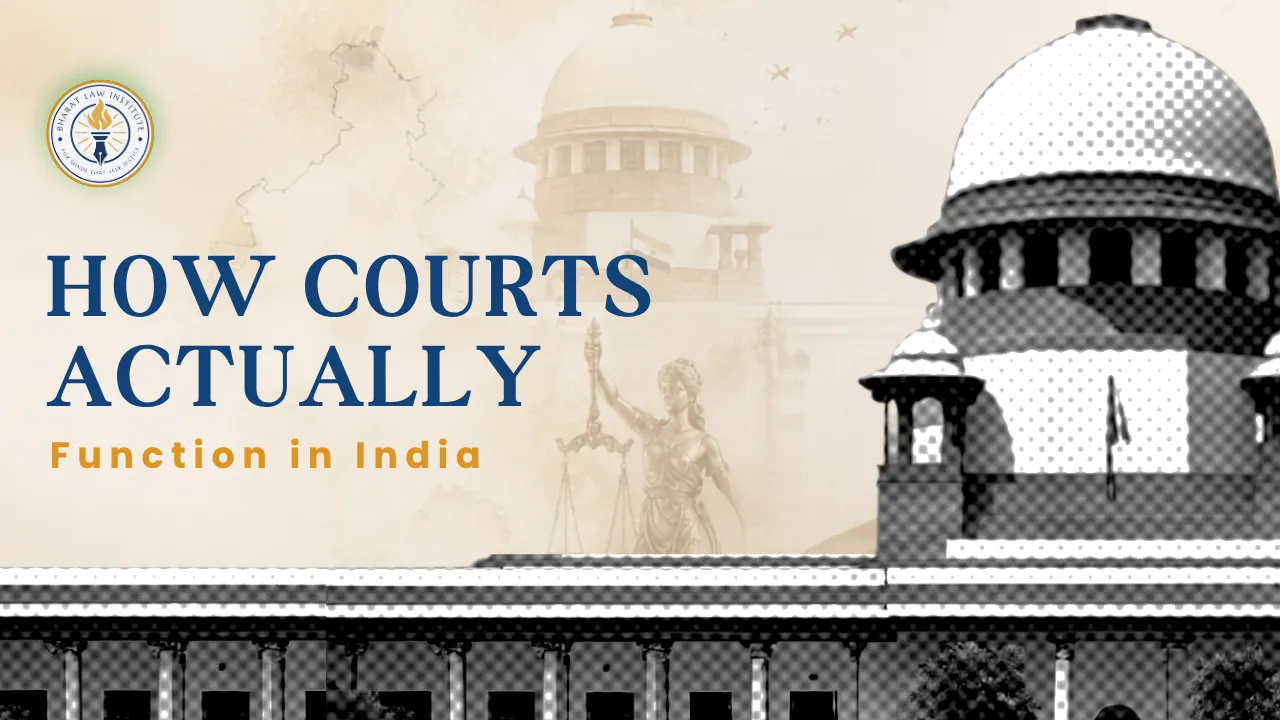
Most People Understand Courts Through Movies, Headlines, or Personal Frustration
For many citizens, the image of Indian courts comes from dramatic courtroom scenes.
A lawyer argues loudly.
A judge delivers an emotional verdict.
The truth suddenly appears in a few minutes.
Real courts rarely function like that.
In reality, the Indian judicial system is a deeply structured process involving:
- Procedures
- Documentation
- Arguments
- Evidence
- Timelines
- Interpretation of law
- Human judgment
- Administrative pressure
For someone entering a courtroom for the first time, the system can feel confusing, slow, and overwhelming.
But behind that complexity, courts perform one of the most important functions in a democracy.
They attempt to resolve conflicts, protect rights, interpret laws, and maintain constitutional balance in society.
How Courts Function in India
The Indian judicial system works through a hierarchy of courts where different types of disputes are heard and decided according to legal procedure.
Broadly, courts function by:
- Receiving cases
- Examining evidence and legal arguments
- Interpreting laws
- Conducting hearings
- Delivering judgments
- Ensuring justice through legal process
Courts do not function only through emotional arguments or personal opinions.
They function through procedure, documentation, legal reasoning, and constitutional principles.
Why Courts Exist in a Democracy
Courts are not only places where criminals are punished.
They also protect:
- Fundamental Rights
- Constitutional values
- Legal fairness
- Government accountability
- Civil liberties
- Public justice
In a democracy, courts act as one of the major institutions balancing power.
They ensure that even governments and powerful authorities remain subject to law.
Structure of Courts in India
The Indian judicial system follows a hierarchical structure.
Supreme Court of India
The Supreme Court of India is the highest court in the country.
It mainly handles:
- Constitutional matters
- Appeals from High Courts
- Fundamental Rights cases
- Important national legal issues
Its judgments become binding across India.
High Courts
Each state or group of states has a High Court.
High Courts handle:
- Appeals from lower courts
- Civil and criminal matters
- Constitutional issues at state level
- Writ petitions under Article 226
High Courts supervise subordinate courts within their jurisdiction.
District and Subordinate Courts
These are the courts most citizens interact with directly.
They deal with:
- Civil disputes
- Criminal cases
- Family matters
- Property disputes
- Local legal conflicts
Most legal proceedings begin at this level.
What Happens When a Case Reaches Court?
Once a case is filed, the court process usually involves multiple stages.
These may include:
- Filing of petition or complaint
- Notice to the opposite party
- Submission of documents
- Hearings
- Evidence examination
- Arguments by lawyers
- Judicial consideration
- Final judgment or order
Depending on the case type, the process may take weeks, months, or sometimes years.
Why Do Court Cases in India Often Take So Long?
This is one of the most common public frustrations.
Many factors contribute to delays, including:
- Huge number of pending cases
- Limited judicial manpower
- Procedural complexity
- Frequent adjournments
- Documentation requirements
- Slow investigation processes
- Administrative pressure on courts
India handles an enormous volume of litigation, and courts often function under significant workload pressure.
At the same time, legal systems also try to ensure fairness, which requires careful examination instead of rushed decisions.
What Judges Actually Do
Many people assume judges simply listen and announce decisions quickly.
In reality, judges must:
- Interpret laws carefully
- Examine evidence
- Hear both sides fairly
- Maintain courtroom procedure
- Apply constitutional principles
- Balance legal reasoning with justice
Judging often involves difficult interpretation rather than simple right-versus-wrong conclusions.
Two experienced lawyers may argue the same law differently. Even judges sometimes differ in interpretation.
This shows how complex legal decision making can become.
What Lawyers Actually Do Inside Courts
Lawyers are not only “speakers” inside courtrooms.
Their work includes:
- Legal research
- Drafting petitions
- Advising clients
- Preparing arguments
- Analysing evidence
- Interpreting legal provisions
- Negotiating settlements
- Understanding procedure
A large part of legal work happens outside dramatic courtroom moments.
Preparation often matters more than performance.
Why Courtrooms Feel Intimidating to Ordinary Citizens
For someone unfamiliar with legal systems, courts may feel emotionally heavy because they involve:
- Complex procedures
- Formal language
- Delays
- Financial stress
- Social conflict
- Uncertainty about outcomes
Many citizens approach courts during emotionally difficult phases of life such as:
- Family disputes
- Property conflicts
- Criminal accusations
- Financial disagreements
- Personal loss
That emotional pressure itself shapes how people experience the legal system.
How Evidence Matters in Courts
Courts do not function only on claims or emotions.
Evidence becomes extremely important.
This may include:
- Documents
- Witness statements
- Digital records
- Medical reports
- Expert opinions
- Physical evidence
Judges usually rely on legally admissible material while making decisions.
That is why proper documentation becomes critical in legal matters.
Why Procedure Matters So Much in Courts
Many citizens become frustrated with procedural rules.
But procedure exists to ensure fairness.
Without proper procedure:
- Evidence may be manipulated
- Rights may be violated
- Decisions may become arbitrary
- Powerful parties may misuse systems
Legal procedure attempts to create structured and accountable decision making.
Even though it sometimes feels slow, procedure remains central to justice systems.
Difference Between Civil and Criminal Courts
| Civil Matters | Criminal Matters |
|---|---|
| Property disputes | Theft, assault, murder |
| Contracts | Criminal offences |
| Family disputes | Crimes against society/state |
| Compensation-related issues | Punishment-related proceedings |
| Usually between private parties | State prosecutes accused person |
Understanding this distinction helps explain why court procedures differ across cases.
Why Courts Are About More Than Punishment
Many people associate courts only with punishment.
But courts also:
- Protect rights
- Resolve disputes peacefully
- Interpret constitutional values
- Prevent misuse of power
- Maintain legal order in society
In many ways, courts help societies manage conflict without violence.
Myth vs Reality About Indian Courts
| Myth | Reality |
|---|---|
| Courts work like movies | Real courts rely heavily on procedure and documentation |
| Judges decide emotionally | Judgments require legal reasoning and evidence |
| Lawyers only argue loudly | Legal preparation is a major part of advocacy |
| Every delay means corruption | Many delays arise from systemic pressure and backlog |
| Courts only punish criminals | Courts also protect rights and resolve disputes |
Why Understanding Courts Matters for Citizens
Basic legal awareness changes how people understand society itself.
Understanding courts helps citizens:
- Protect rights better
- Understand legal responsibilities
- Avoid misinformation
- Engage more responsibly with public institutions
A democracy functions more strongly when citizens understand how justice systems actually operate.
Final Reality About How Courts Function in India
Indian courts are not perfect systems operating in ideal conditions.
They function within enormous social, administrative, and legal complexity.
At times, the system feels slow.
At times, frustrating.
At times, deeply overloaded.
But despite these challenges, courts remain one of the most important institutions responsible for balancing power, resolving conflict, protecting rights, and interpreting justice within constitutional boundaries.
And perhaps the most important thing to understand is this:
Courts are not only buildings where judgments are delivered.
They are places where society continuously negotiates questions of fairness, responsibility, rights, conflict, and justice itself.
FAQs
How does the Indian court system work?
The Indian court system works through a hierarchy including the Supreme Court, High Courts, and subordinate courts where cases are heard, evidence is examined, and judgments are delivered according to law.
Why do court cases take so long in India?
Delays happen due to heavy case backlog, limited judicial manpower, procedural complexity, adjournments, and administrative pressure.
What is the role of judges in courts?
Judges examine evidence, interpret laws, hear both sides fairly, and deliver legally reasoned decisions.
What do lawyers actually do in court?
Lawyers research law, prepare documents, advise clients, present arguments, analyse evidence, and assist courts during legal proceedings.
What is the difference between civil and criminal courts?
Civil courts mainly handle disputes between individuals or organizations, while criminal courts deal with offences considered crimes against society or the state.