Every New Technology Creates the Same Fear
When calculators became common, people feared mathematics skills would disappear.
When computers entered offices, many believed traditional jobs would vanish completely.
And now, with artificial intelligence generating contracts, summarising cases, and answering legal questions within seconds, a new fear has entered the legal world:
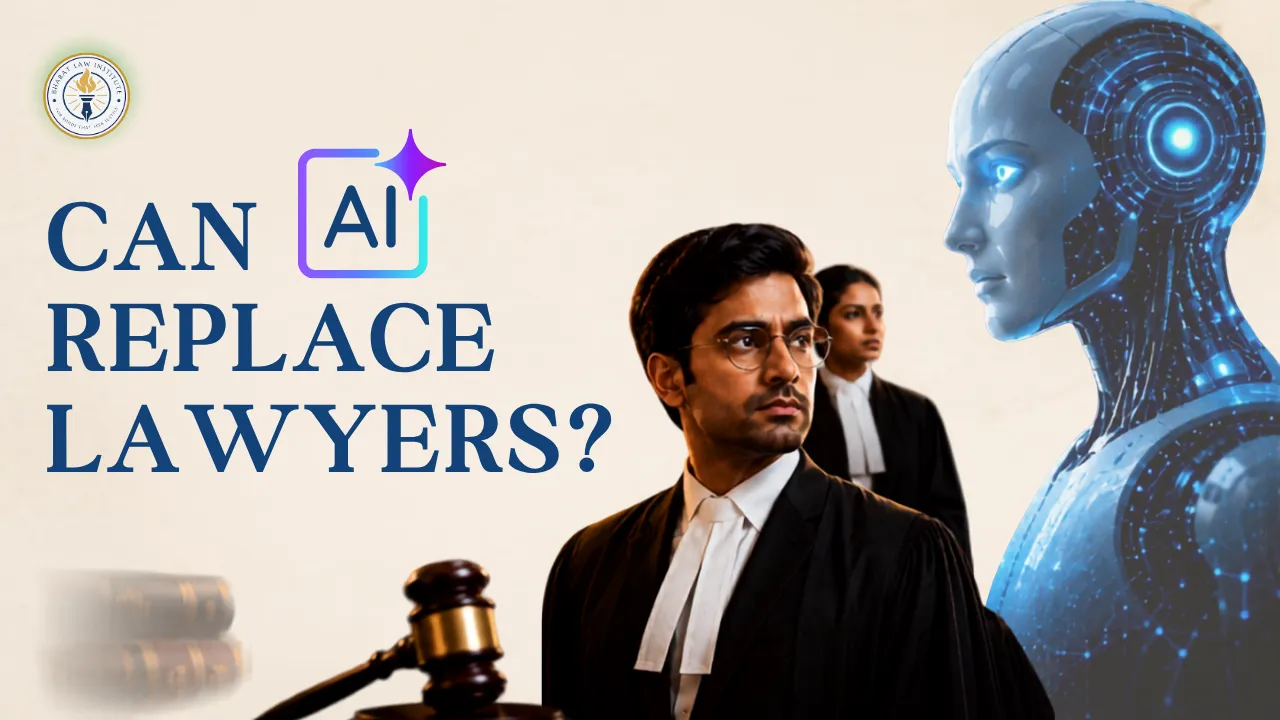
“Will AI replace lawyers in future?”
For many law students, this question feels personal.
Some feel excited by technology.
Some feel anxious about career security.
Some quietly wonder whether years of legal education may eventually lose value.
The discussion has become even stronger because AI tools today can:
- Draft legal documents
- Analyse contracts
- Search case laws quickly
- Summarise judgments
- Generate legal explanations
- Automate repetitive research tasks
From the outside, it sometimes appears as if machines are slowly entering spaces that once required trained lawyers.
But the reality is more complex than simple replacement.
Can AI Replace Lawyers in Future?
Artificial intelligence will definitely change the legal profession.
But replacing lawyers completely is a very different matter.
Law is not only about finding information.
It also involves:
- Human judgment
- Ethical reasoning
- Emotional understanding
- Persuasion
- Interpretation
- Negotiation
- Trust
- Social context
- Responsibility during uncertainty
AI can assist many legal tasks efficiently.
But legal practice often depends on human behaviour, emotions, strategy, and interpretation in ways that technology still struggles to fully understand.
Why AI Is Growing So Fast in Legal Work
AI performs extremely well in repetitive and data-heavy tasks.
For example, AI tools can quickly:
- Search thousands of legal documents
- Identify relevant case references
- Detect patterns inside contracts
- Organise large amounts of information
- Generate first drafts of agreements
- Save research time for lawyers
Earlier, junior lawyers often spent long hours doing manual document review and research work.
Today, AI can complete many such tasks within minutes.
This is why the legal profession is already changing.
What AI Can Do Well in Law
Artificial intelligence is particularly useful in areas involving structure and repetition.
These include:
- Legal research
- Contract analysis
- Document summarisation
- Compliance checking
- Case organisation
- Basic drafting assistance
- Predictive data analysis
Large law firms across the world are already using AI tools to improve speed and efficiency.
For routine work, AI can become extremely powerful.
What AI Still Struggles to Understand
Law is deeply connected to human society.
And human situations are rarely fully predictable.
A courtroom is not simply a database of legal information.
Real legal situations involve:
- Human emotions
- Fear
- Intentions
- Moral conflict
- Social realities
- Psychological pressure
- Unpredictable behaviour
- Ethical dilemmas
A criminal trial, family dispute, constitutional issue, or sensitive negotiation often requires understanding human complexity beyond written law.
This is where human lawyers still matter deeply.
Why Clients Often Need More Than Legal Information
Many people approaching lawyers are not only searching for technical answers.
They are often:
- Confused
- Emotionally stressed
- Financially worried
- Socially vulnerable
- Mentally exhausted
A lawyer may need to:
- Build trust
- Understand emotional realities
- Negotiate carefully
- Persuade human beings
- Read behavioural signals
- Make strategic decisions under uncertainty
These are deeply human interactions.
Technology can support them, but replacing them entirely is much more difficult.
Will Some Legal Jobs Change Because of AI?
Yes. Definitely.
The legal profession may not disappear, but many roles inside it will evolve.
Routine work that depends heavily on repetitive research or standard documentation may reduce over time.
This means future lawyers may need stronger skills in:
- Strategic thinking
- Advocacy
- Negotiation
- Communication
- Human judgment
- Legal interpretation
- Client counselling
- Ethical reasoning
Lawyers who only perform repetitive work may face more pressure in the future than lawyers who develop deeper human and analytical skills.
Why Human Judgment Still Matters in Courts
Courts do not function only through information.
They function through interpretation and judgment.
Even highly experienced judges sometimes disagree on:
- Constitutional interpretation
- Intent behind actions
- Social impact of decisions
- Fairness and justice
- Balancing rights and responsibilities
This itself shows that law is not purely mechanical.
If trained judges can interpret the same law differently, it becomes difficult to assume that legal reasoning can always be fully automated.
Can AI Replace Courtroom Advocacy?
Courtroom advocacy involves much more than speaking legal sections.
Advocates often need to:
- Read the mood of the courtroom
- Respond instantly to arguments
- Adapt strategy dynamically
- Persuade judges
- Handle emotional clients
- Cross-question witnesses
- React to unpredictable developments
These situations require real-time human adaptability.
Technology may assist preparation, but live human interaction remains central in advocacy.
Why Many Law Students Are Both Excited and Nervous About AI
Law students today are entering the profession during a major technological shift.
Some fear:
- Fewer traditional jobs
- Increased competition
- Automation of junior-level work
At the same time, many students also recognise opportunities.
Lawyers who understand both:
- Legal systems
- Modern technology
may become extremely valuable in the coming years.
The profession is not necessarily shrinking.
It is transforming.
What Kind of Lawyers May Become More Valuable in Future?
Future legal professionals may need to become stronger in areas where humans naturally outperform machines.
These include:
- Critical thinking
- Negotiation
- Human communication
- Ethical decision making
- Strategic advocacy
- Emotional intelligence
- Complex interpretation
- Leadership in legal environments
Technical knowledge will remain important, but human judgment may become even more valuable.
Myth vs Reality About AI and Lawyers
| Myth | Reality |
|---|---|
| AI will completely replace lawyers | AI is more likely to transform legal work |
| Legal profession will disappear | Legal roles may evolve, not vanish |
| AI understands justice like humans | AI mainly processes patterns and data |
| Technology removes need for advocacy | Human persuasion still matters deeply |
| Only technical legal knowledge matters now | Human judgment and communication remain critical |
Why Law Is More Human Than Many People Realise
At its core, law is deeply connected to society, morality, conflict, responsibility, and human behaviour.
Legal systems constantly deal with questions like:
- What is fair?
- What is reasonable?
- What is intention?
- What protects society?
- What balances rights properly?
These questions are not always solved through data alone.
They often require human wisdom, social understanding, and ethical interpretation.
That is why law remains deeply human despite technological advancement.
Final Reality About AI Replacing Lawyers
Artificial intelligence will almost certainly reshape the legal profession in significant ways.
Some traditional legal tasks may reduce.
Research and drafting may become faster.
Efficiency may increase dramatically.
But law is not only about processing information.
It is also about understanding people, handling uncertainty, interpreting complex realities, balancing ethics, and making human judgments in emotionally difficult situations.
Technology may become a powerful legal assistant.
But the deeper human side of law still remains difficult to automate completely.
And that is probably why the future of law may belong not to lawyers who fear AI, but to lawyers who understand both technology and human complexity together.
FAQs
Can AI completely replace lawyers in future?
AI may automate certain legal tasks, but completely replacing lawyers is unlikely because legal practice involves human judgment, ethics, negotiation, and emotional understanding.
Which legal jobs are most affected by AI?
Routine tasks like legal research, contract review, document summarisation, and compliance analysis are already being influenced heavily by AI tools.
Will AI reduce opportunities for law students?
Some traditional work may reduce, but new opportunities may emerge for lawyers skilled in technology, strategy, advocacy, and human-centered legal practice.
Can AI argue cases in court like lawyers?
AI may assist legal preparation, but courtroom advocacy requires human adaptability, persuasion, emotional intelligence, and real-time judgment.
Should law students learn about AI?
Yes. Understanding AI and legal technology may become increasingly important for future lawyers and legal professionals.